
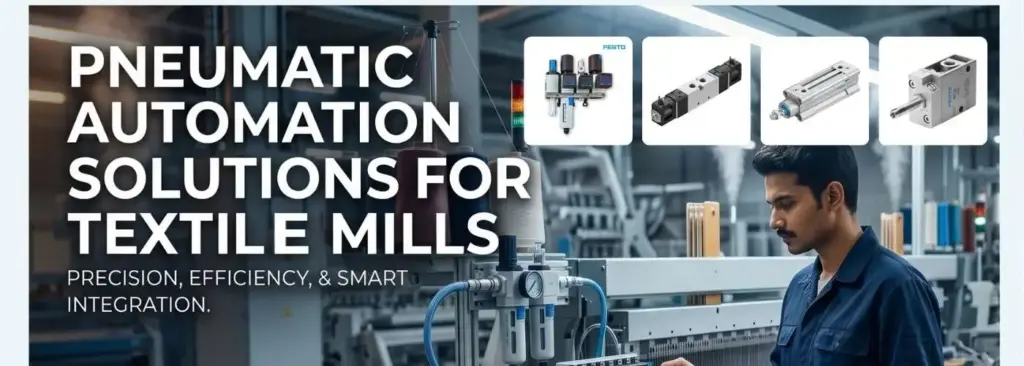
Pneumatic Automation Solutions for Textile Mills in Coimbatore
Coimbatore’s textile industry is one of the largest in India, with hundreds of spinning mills, weaving units, knitting facilities, and garment manufacturing plants operating across the city and surrounding districts. Pneumatic automation is embedded in nearly every stage of the textile manufacturing process — from fibre handling in the blow room to fabric finishing on the stenter frame. Yet many mills still run with outdated pneumatic components that leak air, cycle slowly, and fail unpredictably. This post covers where pneumatic automation adds the most value in textile manufacturing and what to look for when upgrading or replacing pneumatic components.
Where Pneumatics Work in a Textile Mill
Pneumatic actuators and control systems appear throughout the textile production chain. Understanding where they operate — and what they do — helps mill engineers identify the areas where upgrades deliver the greatest return.
Spinning Mills
In the blow room, pneumatic cylinders control the opening and closing of feed rollers, lap formers, and waste removal flaps. These actuators cycle thousands of times per day and must respond quickly to maintain consistent fibre flow. A slow or sticky cylinder at this stage introduces unevenness in the lap or chute feed, which carries through to the yarn quality downstream.
At the carding machine, pneumatic actuators control the flat setting, doffer comb positioning, and can stripping mechanisms. Precision matters here — a cylinder that doesn’t return to exactly the same position on every cycle creates variation in the card sliver that amplifies through drawing and roving.
Ring spinning frames use pneumatic systems for doffing — the automated removal of full bobbins and replacement with empty ones. Doffing systems typically use multiple compact cylinders working in coordinated sequence. A failure in any single cylinder stops the doffing cycle, which stops the spinning frame, which stops production on that frame until the cylinder is replaced or repaired.
Auto-coner and winding machines use pneumatic actuators for yarn tensioning, knot cutting, splice control, and package doffing. These applications demand high-speed, low-force actuation with excellent repeatability — exactly the operating profile of Festo’s ADN compact cylinder series.
Weaving Mills
Modern shuttle-less looms — rapier, air-jet, and projectile types — rely heavily on pneumatic systems. Air-jet looms, by definition, use precisely controlled compressed air to propel the weft yarn across the shed. The relay nozzles, main nozzle, and stretch nozzle all depend on fast-switching solenoid valves and clean, dry, pressure-stable compressed air.
Even on rapier and projectile looms, pneumatic cylinders handle warp beam loading, cloth roll doffing, selvage tucking, and temple adjustments. These are lower-speed applications compared to the air-jet nozzle system, but reliability is equally critical — an unplanned loom stoppage directly reduces metres of fabric produced per shift.
Sizing machines (slashers) use pneumatic cylinders for squeeze roller pressure control, size box level adjustment, and beam changing. Consistent squeeze pressure is essential for uniform size pick-up, which directly affects weaving efficiency and fabric quality.
Knitting and Garment Units
Circular knitting machines use pneumatic systems for yarn feeding tension control, fabric take-down roller pressure, and needle selection in electronic jacquard systems. Flat knitting machines use pneumatic actuators for carriage return mechanisms and fabric pull-down systems.
In garment manufacturing, pneumatic cylinders power cutting machines, pressing equipment, button-attach machines, and fabric spreading systems. These applications are typically lower-cycle but high-force, and they benefit from the DSBC series cylinders that provide robust performance across a wide range of force requirements.
Common Problems in Mill Pneumatic Systems
Three issues account for the majority of pneumatic-related downtime and energy waste in Coimbatore’s textile mills.
Compressed Air Quality
Textile mills often neglect air preparation. Compressed air from the compressor contains moisture, oil particles, and solid contaminants that degrade pneumatic components from the inside out. Moisture causes internal corrosion in cylinder barrels and valve bodies. Oil contamination swells and deteriorates seals. Solid particles score the cylinder bore and damage valve seats.
The solution is proper air preparation at the point of use — not just at the compressor room. Festo’s MS series FRL (Filter-Regulator-Lubricator) units provide three-stage air treatment: filtration to remove particles (down to 5 micron standard, 0.01 micron for fine filtration), regulation to stabilise pressure at the required level, and lubrication where needed. Installing an MS-series FRL unit at each machine or machine group is one of the highest-return investments a mill can make in pneumatic reliability.
Air Leaks
A typical textile mill with 50–100 machines and several hundred pneumatic connections loses 20–30{114bc4bc08256cde1d1127f8c533b06047e321466f951f60acb52ddea13b3589} of its compressed air to leaks. At an energy cost of approximately ₹0.50–₹0.75 per cubic metre of compressed air, a mill running 300 days per year can waste ₹3–8 lakh annually on air that leaks out of worn tubing connections, damaged cylinder seals, and corroded valve fittings.
Festo’s QS push-in fittings provide reliable, leak-free connections that are easy to install and service. Unlike barb fittings that rely on hose clamps (which loosen over time from vibration), push-in fittings create a positive seal that maintains its integrity through millions of pressure cycles. Replacing old barb connections with QS push-in fittings across a mill is a straightforward maintenance project that pays for itself within months through reduced air consumption.
Outdated Components
Many mills in Coimbatore still operate with pneumatic cylinders and valves that were installed during the original machine setup, sometimes 15–20 years ago. These components have exceeded their designed service life and operate with degraded seals, worn bearings, and reduced cushioning effectiveness. They still work — but they leak, cycle slowly, and consume more air than modern equivalents.
Replacing end-of-life cylinders with current-generation Festo equivalents delivers measurable improvements in cycle speed, air consumption, and reliability. The dimensional compatibility of ISO-standard cylinders (DSBC for ISO 15552, ADN for ISO 21287, DSNU for ISO 6432) means that a replacement cylinder fits the existing mounting points and connections in most cases, minimising installation time and machine modification.
Selecting the Right Components for Textile Applications
Cylinders for Textile Mills
For doffing systems and high-cycle applications, the ADN compact cylinder is the standard recommendation. Its short overall length fits the space constraints typical of spinning and winding machines, and its ISO 21287 compliance ensures interchangeability.
For loom-related applications — warp beam handling, cloth roll doffing, and heavy-duty clamping — the DSBC profile cylinder provides the force and stroke range needed. Bore sizes of 50–80 mm with stroke lengths of 100–500 mm cover the majority of weaving mill applications.
For light-duty control tasks — flap actuators, guide adjustments, and sensor positioning — the DSNU round body cylinder offers the most cost-effective solution.
Valves for Textile Applications
The VUVG series solenoid valve is well-suited for individual machine point-of-use applications. It’s compact, fast-switching, and available in both 24V DC and 230V AC coil options.
For machines with multiple cylinders controlled from a central location, the VTUG valve terminal consolidates multiple valves onto a single manifold with a common air supply and electrical connection. This simplifies wiring, reduces installation time, and makes troubleshooting easier — instead of tracing individual valve connections across the machine, the maintenance team can check all valves at one location.
Air Preparation for Textile Mills
The MS series modular air preparation system should be specified for every machine or machine group. At minimum, install a filter-regulator (MS-LFR) combination. For machines with cylinders that require lubrication (older designs without self-lubricating seals), add a lubricator (MS-LOE) to the assembly.
For air-jet looms and other applications that demand extremely clean air, specify fine filtration (MS-LFX) with a 0.01 micron element downstream of the standard filter. This removes the micro-particles and oil aerosols that can block the small-diameter relay nozzles on air-jet weaving machines.
Energy Savings: The Compressed Air Opportunity
Compressed air is the most expensive utility in a textile mill on a per-unit-of-energy basis. Generating one unit of mechanical energy from compressed air costs 7–10 times more than generating the same energy from electric motors. This means that every improvement in pneumatic efficiency — reducing leaks, right-sizing cylinders, optimising operating pressure, and maintaining air preparation equipment — delivers a direct and significant reduction in electricity costs.
A practical starting point for any mill is a compressed air audit. Walk the production floor with an ultrasonic leak detector, identify the major leak points, and prioritise repairs based on leak size and accessibility. In most mills, fixing the top 20 leaks eliminates 50–60{114bc4bc08256cde1d1127f8c533b06047e321466f951f60acb52ddea13b3589} of the total leakage, and the entire exercise can be completed in a single weekend shutdown.
Getting Started with Pneumatic Upgrades
Mill engineers looking to improve pneumatic performance don’t need to replace everything at once. A phased approach works best.
Start with air preparation. Install or upgrade FRL units at each machine group. This single step extends the service life of every downstream component and reduces failure rates across the board.
Next, address the highest-failure machines. Identify the machines that consume the most maintenance time for pneumatic issues and replace the worn cylinders and valves on those machines first. Track the reduction in unplanned stoppages to build the case for extending the programme.
Finally, standardise on a single cylinder and valve platform across the mill. Using Festo’s ISO-standard cylinder families and a single valve series simplifies spare parts inventory, reduces training requirements for maintenance staff, and ensures consistent performance across all machines.
Frequently Asked Questions
Which Festo pneumatic cylinder is best for textile spinning mill doffing systems? The Festo ADN compact cylinder (ISO 21287) is the most commonly used cylinder for doffing applications in spinning mills. Its short body length fits the space constraints of ring frames and auto-coners, and it provides reliable performance across the high cycle counts typical of doffing operations.
How much can a textile mill save by fixing compressed air leaks? A typical textile mill with 50–100 machines can waste ₹3–8 lakh annually on compressed air leaks. Fixing the top 20 leak points in a mill usually eliminates 50–60{114bc4bc08256cde1d1127f8c533b06047e321466f951f60acb52ddea13b3589} of total leakage. The repair cost is typically recovered within 2–3 months through reduced compressor energy consumption.
What air quality is required for air-jet weaving looms? Air-jet looms require extremely clean compressed air. At minimum, install a standard filter (5 micron) followed by a fine filter (0.01 micron) to remove micro-particles and oil aerosols that can block the relay nozzles. Festo’s MS-LFR filter-regulator combined with an MS-LFX fine filter provides the required air quality for air-jet weaving.
How often should pneumatic cylinders be replaced in a textile mill? There is no fixed replacement interval — it depends on the application, cycle count, air quality, and operating conditions. However, cylinders showing visible air leaks, reduced speed, inconsistent stroke, or worn cushioning should be replaced promptly. A cylinder that has been in service for 10–15 years in a textile mill environment has likely exceeded its optimal service life, even if it still functions.
Can Festo pneumatic components be used as direct replacements for other brands? Yes, for ISO-standard cylinder series. Festo’s DSBC (ISO 15552), ADN (ISO 21287), and DSNU (ISO 6432) cylinders are dimensionally interchangeable with any other manufacturer’s ISO-compliant cylinders. Mounting dimensions, port sizes, and stroke lengths follow the international standard, so replacement is typically a direct swap with no machine modification required.
What is the advantage of Festo QS push-in fittings over barb fittings in textile mills? Push-in fittings create a positive mechanical seal that doesn’t rely on hose clamps, which loosen over time due to vibration common in textile machinery. QS fittings are also faster to install and disconnect for maintenance, reducing machine downtime during servicing. Over a mill-wide installation, the elimination of slow leaks from loose clamp connections delivers measurable energy savings.
Where can I get Festo pneumatic products for my textile mill in Coimbatore? Murali Pneumatics is an authorised Festo dealer and stockist in Coimbatore with over 30 years of experience serving the city’s textile industry. They carry ready stock of cylinders, valves, FRL units, fittings, and tubing suitable for spinning, weaving, knitting, and garment manufacturing applications, and can provide on-site technical support for specification and troubleshooting.

Founder of BRUsoft and LinksIndia.co.in — helping Indian businesses build their brand online with custom websites and direct lead generation.
List your business on LinksIndia
Get your own brand page with direct WhatsApp leads. Free to start.
List Your Business Free