
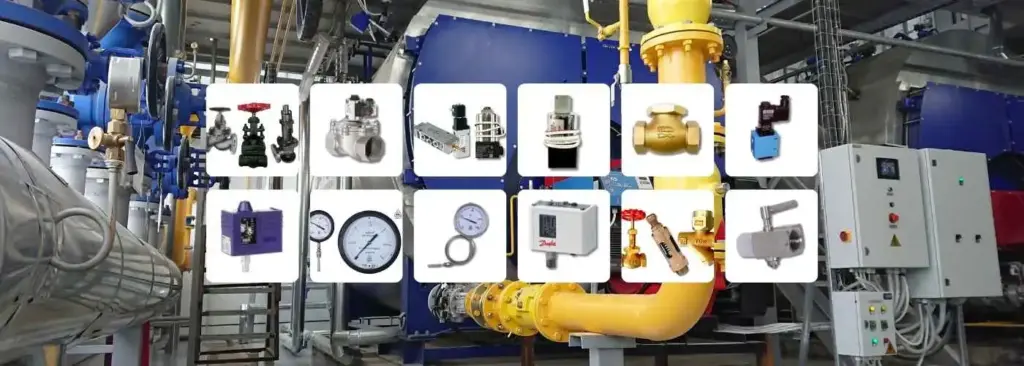
7 Must-Have Boiler Accessories for Industrial Boiler Rooms
7 Must-Have Boiler Accessories for Industrial Boiler Rooms
Whether you are setting up a new boiler house or maintaining an existing one, having the right accessories and mountings is not optional — it is a legal and operational necessity. Under the Indian Boiler Regulations (IBR), every steam boiler operating above 1 kg/cm² pressure and 25 litres capacity must be fitted with specific safety mountings and accessories before it can be commissioned or pass its annual inspection.
This guide covers the seven categories of boiler accessories that every plant engineer, maintenance supervisor, and procurement manager should have on their checklist. We have also included what to look for when sourcing each item and how the right supplier makes a measurable difference to boiler uptime and compliance.
1. Safety Valves
What they do: Safety valves are the single most critical mounting on any boiler. Their job is straightforward — when steam pressure inside the boiler exceeds the preset safe limit, the valve opens automatically and releases excess steam into the atmosphere. Once pressure drops back to the safe range, the valve re-seats.
Why they matter: A malfunctioning or incorrectly calibrated safety valve is the direct cause of boiler explosions. IBR mandates that every boiler must have at least two safety valves, each set at slightly different pressures, so that if one fails, the second acts as a backup.
What to look for when buying:
- IBR-certified spring-loaded safety valves (lever type is outdated for most applications)
- Correct set pressure stamped and certified by an IBR-authorized inspector
- Body material appropriate for your operating conditions — cast steel (WCB) for standard service, stainless steel for corrosive environments
- Brands like WJ and TDK are widely used in Indian boiler rooms and come with Form III-C and Form III-E documentation
Inspection interval: Safety valves must be tested and recalibrated during every annual IBR inspection. Many plants also test them quarterly as a best practice.
2. Pressure Gauges and Siphon Tubes
What they do: Pressure gauges display the real-time steam pressure inside the boiler drum and superheater. They are mounted on the front of the boiler shell where operators can read them at a glance. A siphon tube (a U-shaped or coiled tube) sits between the gauge and the boiler — it fills with condensed water and prevents live steam from reaching the gauge mechanism.
Why they matter: Without accurate pressure readings, operators cannot maintain the boiler within safe operating parameters. An inaccurate gauge is as dangerous as no gauge at all. IBR requires every boiler to have a working pressure gauge, and the siphon tube is mandatory to protect the gauge from heat damage.
What to look for when buying:
- Bourdon tube type pressure gauges (the standard for industrial boilers) with an accuracy class of 1.0 or better
- Dial size appropriate for your boiler room layout — 100mm or 150mm diameter is most common
- Glycerine-filled gauges for environments with vibration
- Diaphragm seal gauges where the process medium is corrosive
- H Guru (North) is one of the most widely specified pressure gauge brands in Indian industrial applications, offering the full range from standard bourdon tube to diaphragm seal types
Maintenance tip: Replace siphon tubes if they show signs of corrosion or blockage. A blocked siphon means live steam reaches the gauge, which gives false readings and damages the gauge mechanism.
3. Water Level Indicators (Gauge Glasses)
What they do: Water level indicators — also called gauge glasses — are mounted on the front of the boiler drum and show the water level inside the boiler in real time. They consist of a toughened glass tube connected to the boiler at two points (one above and one below the waterline), with three independent cocks: a steam cock at the top, a water cock at the bottom, and a drain cock.
Why they matter: Maintaining the correct water level is fundamental to safe boiler operation. If the water level drops too low, the boiler’s heating surfaces get exposed to steam instead of water, leading to overheating, tube failure, and potentially a catastrophic explosion. IBR requires every boiler rated at 100 kW or above to have at least two water level indicators.
What to look for when buying:
- Tubular gauge glass for boilers operating below 17 bar
- Flat (reflex or transparent) gauge glass for high-pressure boilers above 17 bar
- Metal ball check on the water side — this automatically seals the connection if the glass breaks, preventing water loss and steam injury
- Gauge cock sets (2-way and 3-way) from IBR-certified manufacturers
Daily check: Operators should blow through the gauge glass at least once per shift to verify both the steam and water connections are clear and the reading is accurate.
4. Gauge Cocks (2-Way and 3-Way)
What they do: Gauge cocks are small isolating valves that control the connection between the boiler and the water level indicator. A 2-way gauge cock has an inlet and an outlet — it simply opens or closes the connection. A 3-way gauge cock adds a drain port, allowing the operator to blow through the gauge glass for testing without removing any components.
Why they matter: Gauge cocks are small but critical. A leaking or seized gauge cock means the water level indicator cannot be isolated for maintenance, and it can give false readings that mask a dangerously low water level.
What to look for when buying:
- IBR-certified brass gauge cocks (IBR brass is the standard material for boiler mountings in India)
- TDK brand IBR brass boiler mountings are among the most widely used in Indian boiler rooms
- Ensure the cock handle material can withstand the operating temperature — plastic handles crack at high temperatures
- Stock spares — gauge cocks are wear items that need periodic replacement
5. Steam Traps
What they do: Steam traps are automatic valves that discharge condensate (water formed when steam gives up its heat) and non-condensable gases (like air) from the steam system, without allowing live steam to escape. They sit at low points in steam lines, at the outlet of heat exchangers, and at drip legs in the distribution system.
Why they matter: A failed steam trap is one of the biggest sources of energy waste in an industrial boiler system. A single stuck-open trap on a 150mm steam line can waste thousands of rupees worth of steam per month. Conversely, a stuck-closed trap causes condensate to back up, leading to water hammer — violent shockwaves in the steam piping that can rupture joints and damage equipment.
What to look for when buying:
- Thermodynamic traps for main steam lines and drip legs (simple, compact, work across wide pressure ranges)
- Inverted bucket traps for process applications where continuous condensate discharge is needed
- Float traps for heat exchangers and jacketed vessels
- Stainless steel body traps for corrosive condensate or high-purity applications
- WJ brand stainless steel steam traps are used in Indian installations where IBR-grade materials are specified
Maintenance tip: Implement a steam trap survey programme — test every trap at least annually using ultrasonic or temperature-based methods. Industry data suggests that 15–30% of steam traps in a typical plant are either failed-open or failed-closed at any given time.
6. Blow Down Valves
What they do: Blow down valves are used to discharge water from the bottom of the boiler drum to remove accumulated sludge, sediment, and dissolved solids. There are two types of blowdown: intermittent (bottom) blowdown, which removes heavy sludge that settles at the bottom of the drum, and continuous blowdown, which removes dissolved solids from the water surface to maintain water chemistry within limits.
Why they matter: Without regular blowdown, dissolved solids and sludge accumulate inside the boiler, leading to scale formation on heating surfaces. Scale acts as an insulator — even a thin layer of 1mm reduces heat transfer efficiency and forces the boiler to consume more fuel. Severe scaling causes tube overheating and eventual failure.
What to look for when buying:
- IBR-certified blow down valves rated for your boiler’s maximum working pressure
- Quick-opening type for intermittent blowdown (allows rapid, short-duration blowdown)
- Slow-opening type for continuous blowdown (allows fine adjustment of blowdown rate)
- Body material: forged steel for high-pressure applications, cast steel for standard service
Operational guideline: Intermittent blowdown should be performed at least once per shift for most industrial boilers. The duration and frequency depend on feedwater quality — plants with poor water quality may need more frequent blowdown cycles.
7. Feed Check Valves
What they do: The feed check valve is a non-return valve fitted on the boiler shell, slightly below the normal water level. It allows feedwater from the feed pump to enter the boiler but prevents boiler water and steam from flowing back toward the pump when the pump is stopped or operating at lower pressure than the boiler.
Why they matter: Without a properly functioning feed check valve, high-pressure steam from the boiler can flow backwards into the feed line when the pump stops. This causes damage to the feed pump, disrupts the feedwater system, and can create dangerous pressure conditions in the feed piping — which is typically not rated for full boiler pressure.
What to look for when buying:
- IBR-certified feed check valves rated for boiler working pressure plus a safety margin
- Lift check type is standard for boiler feed applications
- Correct size matching the feed line diameter — undersized valves restrict flow and reduce boiler output
- Ensure the valve seats are easily replaceable as they are subject to erosion from feedwater impurities
Quick-Reference Checklist: Boiler Room Accessories
| Accessory | IBR Mandatory? | Minimum Quantity | Typical Replacement Cycle |
|---|---|---|---|
| Safety Valves | Yes | 2 per boiler | Recalibrate annually; replace seats as needed |
| Pressure Gauges + Siphon | Yes | 1 per boiler (2 recommended) | Recalibrate annually; replace gauge every 3–5 years |
| Water Level Indicators | Yes | 2 per boiler (≥100 kW) | Replace glass as needed; overhaul annually |
| Gauge Cocks | Yes | Per indicator (2 or 3 per set) | Replace when leaking or seized |
| Steam Traps | No (but critical) | Per application | Survey annually; replace failed units immediately |
| Blow Down Valves | Yes | 1 bottom + 1 continuous (for larger boilers) | Inspect annually; replace seats as needed |
| Feed Check Valves | Yes | 1 per feed line | Inspect annually; replace seats as needed |
Where to Source Boiler Accessories in India
Sourcing IBR-certified boiler accessories requires a supplier who can provide genuine products with proper documentation — specifically Form III-C (material test report) and Form III-E (manufacturer’s certificate) for IBR-grade components. Buying from unauthorized sources risks non-compliant products that will fail IBR inspection and, more importantly, compromise boiler safety.
V.S. Machinery & Spares, based in Chawri Bazaar, Delhi, is one of India’s most established industrial spares dealers with over 50 years of experience. They are authorized dealers for WJ IBR Valves (globe valves, gate valves, safety relief valves, steam traps), TDK boiler mountings (IBR brass gauge cocks, boiler mounting sets), and H Guru pressure gauges and temperature gauges. They also stock Danfoss pressure switches and burner nozzles.
For quick quotations, you can reach V.S. Machinery directly via WhatsApp at +91 8368543567, or visit their storefront on LinksIndia to browse their full product catalog.
Related Reading on LinksIndia
- IBR vs Non-IBR Valves — Key Differences Every Plant Engineer Should Know
- Where to Buy Janatics Pneumatic Spares in Delhi — Authorized Dealers
- Top Industrial Spares Dealers in Chawri Bazaar, Delhi
Published on LinksIndia.co.in — India’s brand-first B2B business directory. Find verified industrial suppliers and contact them directly via WhatsApp.

Founder of BRUsoft and LinksIndia.co.in — helping Indian businesses build their brand online with custom websites and direct lead generation.
List your business on LinksIndia
Get your own brand page with direct WhatsApp leads. Free to start.
List Your Business Free