
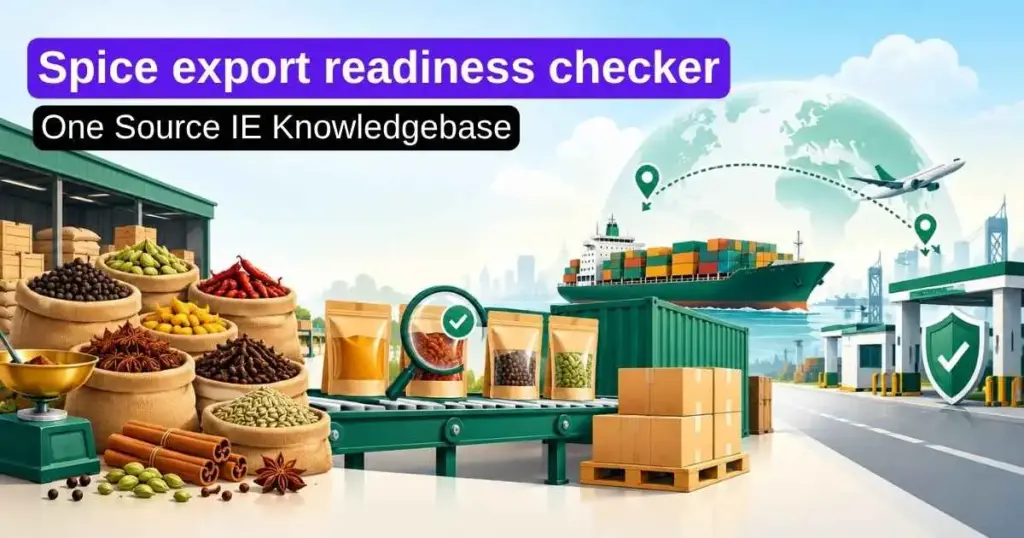
How to Export Spices from India
One Source IE Knowledgebase · Guide 8
A step-by-step guide to exporting spices from India in 2026, covering Spices Board registration (CRES, which doubles as the RCMC), FSSAI licensing, the quality and safety controls buyers and customs actually check (pesticide MRLs, aflatoxins, ethylene oxide), packing and labelling, and the extra conditions that apply when shipping to the EU, US, UK and Gulf markets. It covers the June 2026 tightening of EU checks on Indian spices under Regulation 2019/1793, US FDA Import Alerts on Indian spice exporters through 2026, documents and payment, and a first-shipment plan, with a free interactive readiness checker. Checked against official sources on 8 October 2026.
To export spices from India you need an IEC, GST registration, and a Certificate of Registration as Exporter of Spices (CRES) from the Spices Board — the statutory licence for all 52 notified spices, which also serves as your RCMC. Most exporters also need an FSSAI licence as a food business. None of that gets a container past customs at the other end: the buyer’s market sets the real bar, through pesticide residue limits, aflatoxin and ethylene oxide testing, and destination-specific checks that the EU tightened again in June 2026 and that have put Indian spice exporters on US FDA Import Alerts through 2026. Registration gets you the right to export; clean lab results on every lot are what get your consignment released.
Spice export readiness checker
Answer four questions and get a checklist for your product and market. It runs in your browser and stores nothing.
General guidance. Your specific spice, buyer and bank may require more, so confirm with the Spices Board regional office and your customs broker.
What changed in 2026 for spice exporters: the live tracker
The registration steps have not moved much. What has moved is how hard buyers' markets check your spices, newest first.
| Date | Status | What changed | What to do | Official reference | Next check |
|---|---|---|---|---|---|
| Aug–Sep 2026 | Enforcement | A Hyderabad spice exporter was placed on the US FDA's Red List under Import Alert 99-19 for Salmonella, its second FDA alert in about 15 months (an earlier one, in June 2025, was for aflatoxins under Import Alert 23-14). Listed shipments can be detained without physical examination. | Check the FDA's current import alert list for your product category, and your own company name, before every US shipment. | FDA Import Alert 99-19 (as reported) | Before each US shipment |
| 9 Jun 2026 | In force | The European Commission adopted Implementing Regulation (EU) 2026/1206, amending Regulation 2019/1793. Cumin seeds from India now face a 30% physical-check rate for pesticide residues; cinnamon and cinnamon-tree flowers moved from Annex II special conditions into Annex I at 20% for ethylene oxide; dried spices in Annex II were split into finer product groups (nutmeg/mace/cardamom; anise/star anise/fennel/coriander/cumin/caraway/juniper; ginger/saffron/turmeric/thyme/bay leaves/curry and others) for more targeted checks. | Re-check which Annex and check rate applies to your exact spice and HS code before booking an EU shipment. | Commission Implementing Regulation (EU) 2026/1206, 9 Jun 2026 | On the next EU amendment, typically twice a year |
| 15 Jul 2026 | In force | The India-UK CETA gives zero duty on about 99% of tariff lines, which includes many spice HS codes, if the buyer claims it with a valid proof of origin. | Check your HS code against the UK Trade Tariff and register for the eCoO self-declaration route if UK buyers ask for it. See Guide 7. | DGFT Trade Notice 11/2026-27 | Per UK shipment |
| Since Apr 2024 | Background | India raised the default MRL for unregistered pesticides in herbs and spices tenfold, from 0.01 mg/kg to 0.1 mg/kg, to align with Codex. Importing markets did not raise their own limits to match, so a lot that is compliant in India can still fail in the EU or US. | Test against the destination market's MRL table, not only the Indian one. | FSSAI notification, Apr 2024 | On the next FSSAI pesticide notification |
| Ongoing since 2020 | Background | Ethylene oxide, used by some processors to sterilise spices against Salmonella and E. coli, remains the single largest cause of EU notifications against Indian spices and sesame under the EU's rapid alert system (RASFF), with hundreds of notifications recorded between 2020 and 2024. | Avoid ethylene oxide treatment; the Spices Board has asked exporters to use steam sterilisation instead and to test raw material, processing aids, packaging and finished goods. | EU RASFF data; Spices Board advisories | Before each lot you treat or buy pre-treated |
Last verified: 8 October 2026. Status key: In force Enforcement / background risk Recurring or background
Spices Board registration: the CRES
Before IEC and GST, this is the licence specific to your product. The Certificate of Registration as Exporter of Spices (CRES) is issued by the Spices Board of India, a statutory body under the Ministry of Commerce and Industry, under the Spices Board Act, 1986. It is mandatory for anyone commercially exporting any of the 52 notified spices, and one certificate covers all of them — you do not register separately per spice.
1. Confirm you have a PAN-based business entity, GST registration and an active IEC
2. Apply online on the Spices Board portal (indianspices.com)
3. Upload documents and pay the fee online
4. Regional office review
5. Receive the CRES, which also serves as your RCMC
If you sell under an organic claim, the CRES does not cover that separately: you need certification under India's National Programme for Organic Production (NPOP) from an accredited certifying body, on top of the Spices Board registration.
FSSAI and other licences you may also need
Spices are food, so the Food Safety and Standards Authority of India (FSSAI) licensing requirement sits alongside, not instead of, the CRES.
| Licence | Issued by | When you need it |
|---|---|---|
| FSSAI licence (State or Central, by turnover and activity) | FSSAI, via FoSCoS | Food business operators handling, processing or exporting food, spices included; exporters and large processors typically fall under the Central licence |
| NPOP organic certification | An APEDA-accredited certification body | Only if you make an organic claim on the pack or in your documents |
| Halal certification | An accredited halal certification body | When the buyer, importer regulation or retail chain in the destination market asks for it; common for Gulf markets |
| GI (Geographical Indication) usage rights | The registered GI proprietor body | Only if you market a specific spice under a protected GI name, such as certain regional chilli or turmeric varieties |
Export Promotion Council / commodity board RCMC from a body other than the Spices Board is not normally needed for spices, since the CRES already functions as your RCMC for this product category.
The quality controls that actually decide whether your shipment lands
Registration proves who you are. Lab results prove what is in the bag. Almost every spice shipment that gets detained, rejected or destroyed fails on one of these three, not on paperwork:
What to test, and when
- Before you commit to a buyer: pesticide residue screen, aflatoxin (for products at risk such as nutmeg, chilli, pepper), ethylene oxide, Salmonella and moisture, on a representative sample of the actual lot.
- Use a NABL-accredited lab, or one the Spices Board recognises, and keep the certificate with the lot number it tested.
- Re-test after any treatment such as steam sterilisation, fumigation or irradiation, since the treatment itself can change residue levels.
- Match the test panel to the market: the EU's Annex II list in Regulation 2019/1793 names a required analytical certificate for some spices; the US does not mandate a specific pre-shipment certificate but a Salmonella-positive result found at the US border triggers detention regardless of what your own lab said.
Shipping to the European Union
The EU runs the strictest, most product-specific checks on Indian spices of any major market, under Commission Implementing Regulation (EU) 2019/1793, as amended (most recently by Regulation 2026/1206 of 9 June 2026).
- Annex I spices face a fixed rate of identity and physical checks at the EU border (rates vary by spice and commonly run 10–50%); after the June 2026 amendment this includes cumin seeds from India at 30% for pesticide residues and cinnamon/cinnamon-tree flowers at 20% for ethylene oxide.
- Annex II spices need prior notification before the consignment arrives, through the EU's TRACES system (the CHED-D health certificate route), plus an official certificate and test results travelling with the shipment. The June 2026 amendment split Annex II dried spices from India into finer groups: nutmeg/mace/cardamom; anise/star anise/fennel/coriander/cumin/caraway/juniper berries; and ginger/saffron/turmeric/thyme/bay leaves/curry and other spices.
- The ethylene oxide limit is 0.1 mg/kg (sum of ethylene oxide and 2-chloroethanol, expressed as ethylene oxide) under EU pesticide residue rules, which is the single biggest reason Indian spice and sesame consignments get flagged on RASFF.
- Rules shift by amendment roughly twice a year. Check the current Annex I/II status for your exact spice and HS code before every EU shipment; what applied six months ago may not apply now.
Shipping to the United States
The US does not run an EU-style prior-notification system for spices, but the Foreign Supplier Verification Program (FSVP) rule puts the compliance burden on your US importer, and the FDA uses Import Alerts aggressively once a pattern of violations shows up.
- Your US buyer, as the FSVP-responsible importer, must verify that your spices are produced to US food safety standards. They will ask you for process controls, hazard analysis and lab data; exporters who cannot supply this lose US buyers even without ever being personally listed.
- If the FDA finds repeated violations tied to your company or a product category, it can issue an Import Alert (such as the Red List under Import Alert 99-19 for Salmonella, or 23-14 for mycotoxins including aflatoxins), after which listed shipments can be detained without physical examination until you demonstrate the problem is fixed.
- Salmonella is consistently the single most cited reason for FDA refusals of Indian spice and botanical shipments; keep it as your top test priority for this market.
- Check the FDA's current import alert lists for your spice category, and your own company name, before each US shipment, since alerts are added and removed through the year.
UK, Gulf and other markets
- United Kingdom: the India-UK CETA (in force 15 July 2026) gives zero duty on most tariff lines, spices included, if your buyer claims it with a valid proof of origin — see Guide 7 for the eCoO process. The UK's own food safety checks on Indian spices have tightened in recent years independently of the trade deal, so treat it as a serious market, not a soft one.
- Gulf / Middle East: halal certification is commonly expected even when not legally mandatory for the product category; some countries run their own conformity or SASO-style certification for packaged food. Confirm with your buyer or a local agent before the first shipment.
- Other markets (Southeast Asia, Africa, Latin America): requirements vary widely and are often less codified than the EU or US; lean on your buyer's import documentation requirements and keep your own lab testing standard high regardless, since it protects your reputation across every market.
Packing and labelling
- Moisture and odour control: food-grade, moisture-barrier packaging (laminated pouches, lined jute or PP bags for bulk) protects both quality and lab results; spices absorb moisture and odours readily in transit.
- Wooden packaging: pallets and crates need ISPM-15 heat treatment and the official mark, or shipments can be refused at the destination port regardless of what is inside.
- Labelling: match the destination market's food labelling law — ingredient list, net weight in the required units, allergen declarations, country of origin, and importer/distributor details where required. A spec that passes lab testing can still be rejected on the label alone.
- Lot coding: print a traceable lot or batch number on every pack; it is what lets you and the buyer match a rejection or recall back to your test records.
Documents and payment
Spice shipments use the same core export document set as any other goods export — commercial invoice, packing list, shipping bill, transport document, Certificate of Origin where claimed, and the e-BRC after payment — with the lab test report and, for the EU, the health certificate added on top. See Guide 6 for the full document-by-document breakdown and Guide 4 for the nine-month FEMA payment realisation deadline that starts running from your shipment or invoice date.
Your first shipment, step by step
1. Get registered and lab-ready first
2. Pick one product, one grade, one target market to start
3. Test before you sample the buyer
4. Send a sample, agree the contract in writing, including the quality specification
5. Use an experienced customs broker for the HS code and, for the EU, the prior-notification step
6. Ship, track the realisation deadline, and keep the full lot file
Mistakes that get shipments rejected
- Treating spices with ethylene oxide to control Salmonella, instead of steam or an approved alternative.
- Testing only against India's own MRL table and assuming it covers the EU or US as well.
- Letting the CRES lapse because the renewal window was not calendared.
- Selling under an organic label without NPOP certification to back it.
- Using untreated wooden pallets or crates with no ISPM-15 mark.
- Skipping the EU's Annex II prior-notification step because an earlier shipment of a different spice did not need it.
- Not checking the FDA's current import alert list before a US shipment, especially after any prior rejection.
Dates to bookmark
| When | What to do | Applies to |
|---|---|---|
| Every lot, before offering a sample | Lab test for pesticide residues, aflatoxins, ethylene oxide and Salmonella | All spice exporters |
| About 2 months before CRES expiry | File the Spices Board renewal | All CRES holders |
| 1 April each year | File a fresh GST LUT | Exporters under LUT |
| Before each EU shipment | Re-check the current Annex I/II status and check rate for your spice and HS code | EU-bound exporters |
| Before each US shipment | Check FDA import alert lists for your category and company | US-bound exporters |
| Every shipment | Calendar the 9-month FEMA realisation deadline | All exporters |
Glossary
CRES
Certificate of Registration as Exporter of Spices, the Spices Board's mandatory export licence covering all 52 notified spices.
RCMC
Registration-cum-Membership Certificate. For spices, the CRES itself serves this purpose.
MRL
Maximum Residue Limit, the ceiling on pesticide residue a market allows in a food product.
Ethylene oxide (ETO)
A sterilising agent sometimes used on spices against Salmonella and E. coli; the EU limit on its residues is 0.1 mg/kg and it is not an approved pesticide in the EU.
Aflatoxin
A toxin produced by certain moulds that can contaminate spices, nuts and grains, tightly regulated by most import markets.
FSVP
Foreign Supplier Verification Program, the US rule requiring American food importers to verify that their foreign suppliers meet US food safety standards.
Import Alert
An FDA mechanism that allows US customs to detain listed shipments without physical examination until the exporter or importer proves the product is compliant.
TRACES / CHED-D
The EU's online system and the health-certificate document used for prior notification of certain food and feed consignments, including listed spices, before they arrive at the EU border.
NPOP
National Programme for Organic Production, India's organic certification framework; required before making an organic export claim.
ISPM-15
The international standard for treating wooden packaging material (pallets, crates) to prevent pest spread, verified by a stamped mark.
Official sources directory
Always confirm on the issuing source. These are the portals this guide relies on.
| Source | Use it for |
|---|---|
| Spices Board of India | CRES registration, renewal, notified spices list |
| FSSAI / FoSCoS | Food business licensing |
| DGFT | IEC, trade notices, eCoO and Trade Connect |
| EUR-Lex | Regulation 2019/1793 and its amendments (Annex I/II status) |
| US FDA | FSVP guidance and current import alerts |
| APEDA | NPOP organic certification bodies |
| Reserve Bank of India | FEMA export payment regulations |
Verified from Spices Board and FSSAI procedure pages, EUR-Lex regulation text, FDA import alert and FSVP guidance, and trade press reporting on 2026 enforcement actions. Confirm on the issuing portal before you rely on a rule.
Frequently asked questions
How do I start exporting spices from India?
Register your business, get a PAN, GST and an IEC from DGFT, then apply for a Certificate of Registration as Exporter of Spices (CRES) from the Spices Board, which also serves as your RCMC. Most exporters also need an FSSAI licence. After that, the real work is lining up lab testing, a buyer and clean documents for your first shipment.
What is CRES and is it mandatory?
CRES stands for Certificate of Registration as Exporter of Spices, issued by the Spices Board of India under the Spices Board Act, 1986. It is mandatory for any business commercially exporting any of the 52 notified spices from India; one CRES covers all of them.
Do I need a separate RCMC for spices?
No. Spices Board guidance treats the CRES itself as your Registration-cum-Membership Certificate (RCMC) for spices, so there is no separate RCMC application to file with the Board for this product category.
How long is the CRES valid, and what does renewal cost?
Spices Board circulars describe a block registration period, commonly quoted as three years, after which you renew. Fees are commonly quoted around ₹5,000 for a new registration and a lower amount for renewal, but confirm current fees on the Spices Board portal, since they are revised from time to time, and check the expiry date on your own certificate.
Do I need an FSSAI licence to export spices?
Yes, in addition to the CRES. Spices are food, and the FSSAI licensing requirement applies to food business operators, exporters included. Apply through the FoSCoS portal.
What is the biggest reason Indian spice shipments get rejected abroad?
Lab results, not paperwork. Pesticide residues above the destination market's limit, aflatoxins, ethylene oxide (used by some processors to sterilise against Salmonella) and Salmonella itself are the recurring causes behind EU notifications and US FDA import alerts on Indian spices through 2026.
What changed for Indian spices entering the EU in June 2026?
The European Commission adopted Implementing Regulation (EU) 2026/1206 on 9 June 2026, amending Regulation 2019/1793. It raised the check rate on cumin seeds from India to 30% for pesticide residues, moved cinnamon and cinnamon-tree flowers into Annex I at 20% for ethylene oxide, and split Annex II dried spices into finer product groups for more targeted checks.
What does the US FSVP rule mean for an Indian spice exporter?
The Foreign Supplier Verification Program puts the legal responsibility on your US importer to verify that your spices meet US food safety standards. In practice, that means your US buyer will ask you for process controls and lab data; exporters who cannot supply this lose US buyers, and repeated violations can lead to an FDA Import Alert that detains shipments without physical examination.
Does India's own pesticide limit for spices match the EU or US limit?
Not necessarily. India raised its default MRL for unregistered pesticides in herbs and spices to 0.1 mg/kg in April 2024, but importing markets did not raise their own limits to match. A lot that passes against the Indian limit can still fail against the EU's or another market's limit, so test against the destination market's table, not only India's.
Do I need organic certification to sell spices as organic?
Yes. An organic claim needs certification under India's National Programme for Organic Production (NPOP) from an accredited certifying body. The CRES and FSSAI licence do not cover this on their own.
What extra steps does the EU require beyond what other markets ask for?
For spices listed in Annex I of Regulation 2019/1793, the EU runs fixed-rate identity and physical checks at the border. For Annex II spices, you also need prior notification through the EU's TRACES system (the CHED-D health certificate route) and an official certificate with test results travelling with the shipment, before the consignment arrives.
Is the India-UK CETA relevant to spice exports?
Yes. In force since 15 July 2026, it gives zero duty on about 99% of UK tariff lines, spices included, if your buyer claims it with a valid proof of origin. See Guide 7 for the eCoO process.
Knowledgebase series and change log
How to export spices from India, with the readiness checker
Coming next: 12 export-import scams in India and how to spot each one, and a landed-cost calculator.
Change log
| Date | Update |
|---|---|
| 8 Oct 2026 | First published. Verified: Spices Board CRES process and fees; FSSAI licensing for spice exporters; EU Implementing Regulation 2026/1206 (9 Jun 2026) changes to Regulation 2019/1793 Annex I/II for Indian spices; US FDA Import Alert pattern on Indian spice exporters through 2026 (Salmonella, aflatoxins); India's April 2024 pesticide MRL change for herbs and spices; India-UK CETA relevance for spice HS codes. |
We re-check this page whenever the Spices Board, FSSAI, the EU or the US FDA changes a rule that touches spice exports. If you spot something outdated, tell us through the contact page.
Disclaimer. LinksIndia is an independent directory and not a government body, certification body or testing laboratory. This guide is general information and not legal, food-safety or customs advice. Requirements vary by spice, form, destination market and buyer. Confirm with the Spices Board, FSSAI, an accredited testing lab and your customs broker before shipping, and verify EU and US rules on their official portals since they change by amendment.

Founder of BRUsoft and LinksIndia.co.in — helping Indian businesses build their brand online with custom websites and direct lead generation.
List your business on LinksIndia
Get your own brand page with direct WhatsApp leads. Free to start.
List Your Business